
By Lumenci's estimate, a standard high-medium-low (HML) triage of a patent portfolio takes a team of attorneys and associates one to three months. Building the collateral for litigation funding or case filing adds another three to four.
The detailed analysis that follows triage is covered in What Is Patent Portfolio Analysis and Why It Takes So Long. This article covers the step before it: the HML assessment that decides which patents get that analysis at all, what a useful one produces, and which parts AI can take on.
Key Takeaways
An HML assessment sorts every patent into high, medium, or low priority so that expensive review goes where it can pay off.
Four questions drive the sort: how much the claims cover, how well the patent was drafted and prosecuted, whether a product appears to practise it, and whether it would survive a validity challenge.
AI handles the volume well. It is weakest where evidence is hidden inside products and where claim construction decides the outcome.
A High rating starts the litigation readiness work. Claim charts, prior art searches, and damages analysis still follow.
What an HML Patent Portfolio Assessment Produces
The output is a ranked list with a reason attached to each rank. The reason is what makes the list usable. A patent ranked High because it reads on a best-selling product is a different asset from one ranked High because its claims are unusually broad, and each needs a different next step.
High: strong claims, relevant to products on the market, with a visible path to proving infringement. These go to detailed review.
Medium: one strong dimension and one weak, such as broad claims with thin evidence, or clear evidence against a narrow claim. A targeted look decides whether to promote or drop them.
Low: weak on most dimensions, or tied to technology no longer in use. Candidates for non-renewal, sale, or a periodic re-check, which is where the assessment feeds back into wider patent portfolio management.
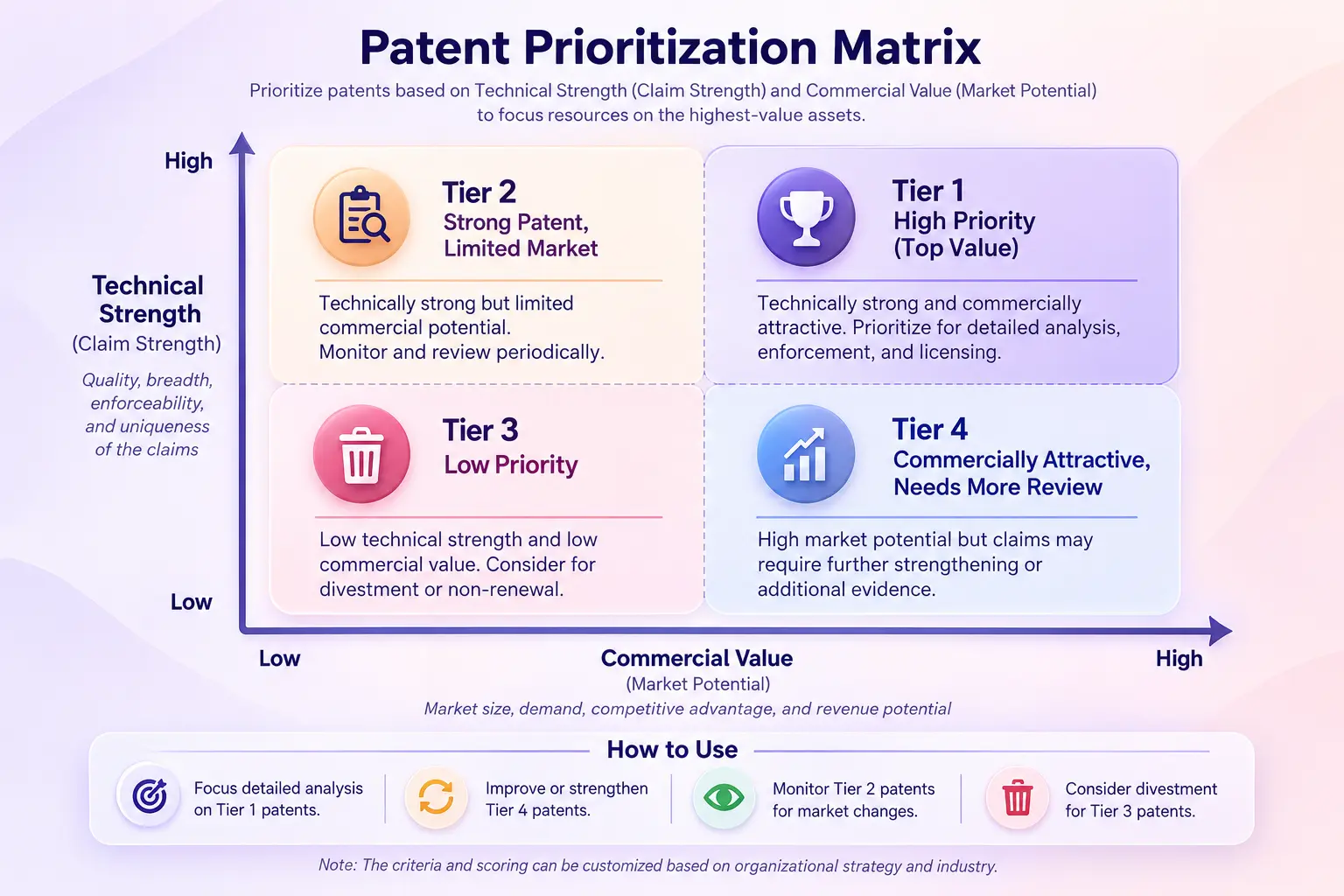
Plotted against claim strength and commercial value, the same logic produces a four-tier matrix.
Still Spending Months
Reviewing Patent Portfolios?
Identify high-value patents, discover licensing opportunities, and prioritize portfolios with expert-powered AI tool built by Lumenci.

Four Questions Behind a Patent Strength Analysis
iLumOS scores each patent on four dimensions: strength, quality, infringement signal, and validity resilience, as set out at launch. Each corresponds to a question an experienced analyst asks during manual triage.
Strength: How Much Does the Patent Cover?
This looks at the independent claims. Fewer limiting elements generally mean broader coverage, and the ease of designing around the claim sets a practical ceiling on its value.
Quality: How Well Was It Drafted and Prosecuted?
Clear claim language with solid support in the specification holds up better when challenged. Amendments made during prosecution can quietly narrow what the claims cover, so the file history is part of the picture.
Infringement Signal: Does a Product Appear to Practise It?
This is the link between the patent and revenue. The question is whether commercial products appear to implement what the claims describe, based on public documentation, specifications, and technical disclosures. The signal is an early indicator, and confirming it takes full patent infringement analysis against the accused product.
Validity Resilience: Would It Survive a Challenge?
An accused infringer's usual first move is to attack validity, often through inter partes review. A patent with close prior art in its field is a riskier asset, however strong the other three scores are.
Where AI Speeds the Assessment, and Where Experts Take Over
AI patent portfolio analysis performs best on the large, structured, repetitive parts of an assessment: grouping patents into families, classifying technology, comparing claim language across thousands of documents, and ranking against defined criteria. Those tasks account for most of the hours in a manual HML pass.
It is weaker in three places. Evidence for features inside firmware, servers, or chips is not visible in public information, so a model can only estimate infringement signal there. Validity depends on prior art the model may not have seen. And claim construction, which often decides whether a claim reads on a product at all, is a legal judgment. For error rates and how to control them, see How Accurate Are AI-Based Patent Analysis Tools? and Automate Patent Portfolio Analysis Without Losing Accuracy.
iLumOS is built around that division of work. The platform runs the first pass across the whole portfolio, and Lumenci's experts take the High-rated patents into detailed review.
Prioritising the Portfolio: The Tier Matrix
Once each patent is scored, plotting claim strength against commercial value sorts the portfolio into four tiers.
Tier 1, strong claims and high commercial value: prioritise for detailed analysis, licensing, and enforcement.
Tier 2, strong claims with a limited market: keep and monitor, since the market can shift.
Tier 3, weak claims and low commercial value: candidates for non-renewal or sale.
Tier 4, high commercial value with weaker claims or thin evidence: review further. Continuation practice or additional evidence gathering can move some of these into Tier 1.
Weightings should follow the business goal. A portfolio being readied for sale is scored differently from one being prepared for an assertion campaign.
From High Rating to Litigation Readiness
A High rating means a patent has earned the expensive work. Before it can be licensed or asserted with confidence, it typically still needs:
Claim charts mapping every claim element to evidence of use.
A prior art search to test the validity score against real references.
Evidence of use preserved in a defensible form, often through product testing.
An early damages estimate to confirm the case is worth pursuing.
Remaining patent life also changes the plan. An expired patent can no longer support an injunction, but 35 U.S.C. § 286 still allows recovery for infringement up to six years before suit. A recently expired patent read on by a high-revenue product can stay in the High tier.
For the full five-stage evaluation Lumenci's experts use to take a patent from triage to litigation readiness, see Patent Portfolio Triage: How to Evaluate a Patent Portfolio for Litigation Readiness.
Conclusion
The slowest part of patent monetization is often deciding where to look. An HML assessment answers that question across the whole portfolio, and the four scores behind it explain each rank rather than just assigning one.
AI makes that first pass fast enough to run on every portfolio instead of the largest ones. Request an iLumOS demo to see a scored portfolio, or talk to Lumenci's experts about taking your High-rated patents forward.





By using this website, you agree to our use of cookies. We use cookies to provide you with a great experience and to help our website run effectively.